- | Government Spending Government Spending
- | Data Visualizations Data Visualizations
- |
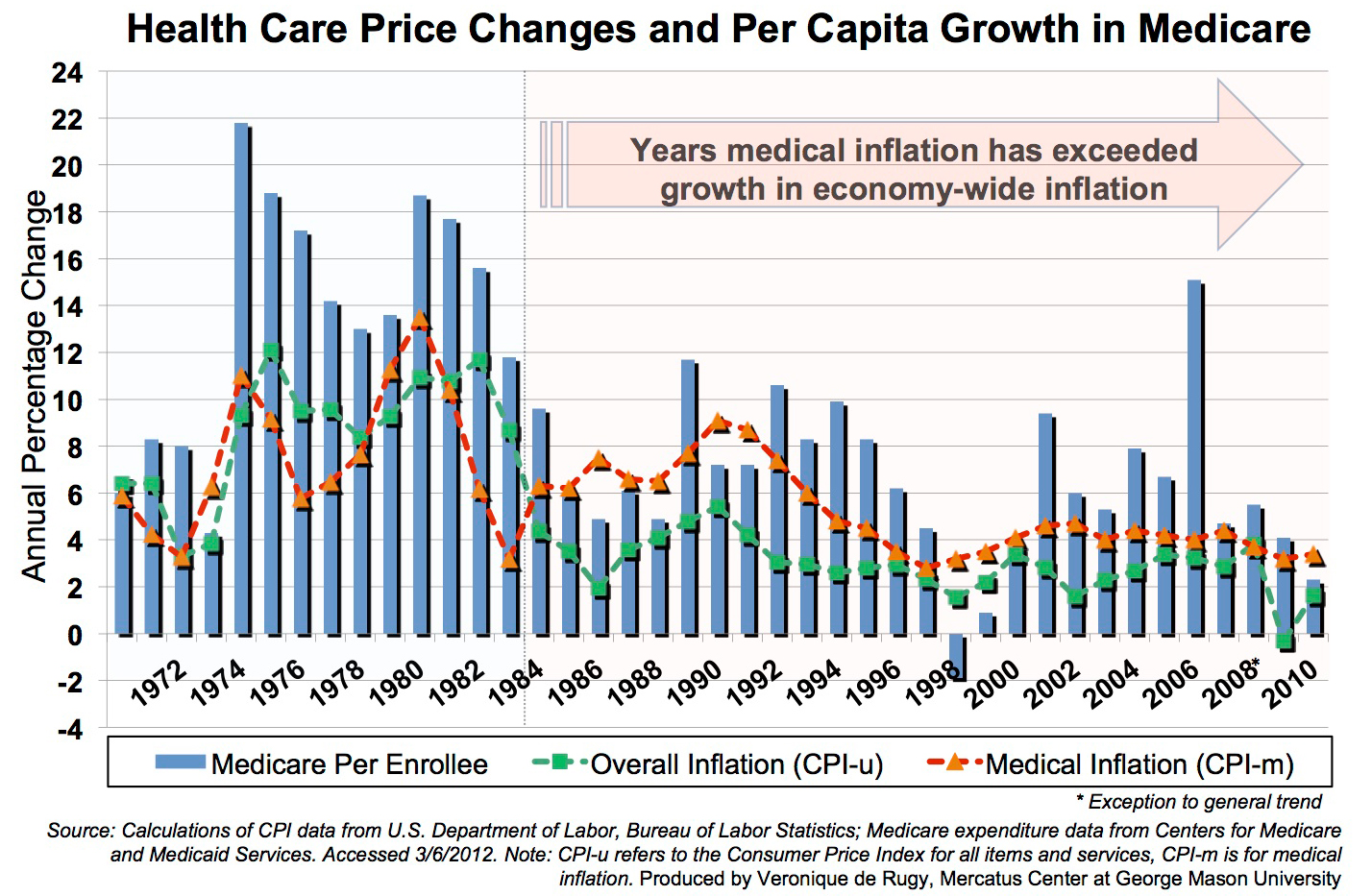
Health Care Price Changes and Per Capita Growth in Medicare
This week, Mercatus Center senior research fellow Veronique de Rugy examines the growth trends in health care in the Consumer Price Index (CPI) against the average inflation rate of all consumer prices and per capita Medicare spending.
This week, Mercatus Center senior research fellow Veronique de Rugy examines the growth trends in health care in the Consumer Price Index (CPI) against the average inflation rate of all consumer prices and per capita Medicare spending.
Changes in health care costs are accounted for in the medical inflation estimate, which accounts for prescription drugs, professional services, hospital services and health insurance. It is important to note, however, as Arnold Kling of EconLog points out that most of the rise in health care spending reflects increased use of expensive inputs in equipment and specialists rather than a pure increase in prices charged for the same services.
Before 1984, the growth in medical inflation fluctuated relative to the growth in economy-wide inflation. This pattern persisted in roughly three-year intervals. By contrast, since 1984 annual price changes in medical care (orange line) has exceeded the average inflation rate of all consumer prices (green line) in every year but one. More specifically, during this same period, health care prices have on average grown 2.1 percentage points higher each year than overall inflation. In a broader context, aggregate Medicare spending during this time period increased on average by 8.6 percent per year, while total federal outlays increased by only 5.6 percent.
Last year the Congressional Research Service alerted Congress: “Had spending per Medicare beneficiary increased at just the rate of overall inflation over the 1985 through 2008 period, per enrollee expenditures in 2008 would have been slightly less than $4,600 as compared to actual 2008 Medicare Part A and Part B expenditures of $9,448 per beneficiary.”
Medicare is still fast approaching insolvency and continually adds to the federal deficit. Serious efforts to reform Medicare must recognize that the persistent trends since 1984 are a recipe for debt disaster.
Veronique de Rugy discusses Medicare reform at NRO's The Corner.
A note on sources: Annual changes in economy-wide inflation were calculated using Consumer Price Index (CPI) data from the Bureau of Labor Statistics (BLS). The growth in medical inflation was calculated using the medical care indexes from the BLS. The CPI-medical care index (CPI-m) accounts for both medical care commodities and services measured by out-of-pocket consumer expenditures. Per enrollee Medicare expenditure data come from the Centers for Medicare and Medicaid Services.